
Deciding to start a private practice is one of the more exciting and terrifying things a clinician can do. You are trading the structure of an agency or hospital setting for something that is entirely yours, which means both the freedom and responsibility are going to feel VERY real. There are decisions to make before you see your first client that will affect how you practice, how much you earn, and how long you last doing this work. This is not an exhaustive list, but it covers the things that tend to catch people off guard.
Business Structure and Credentialing
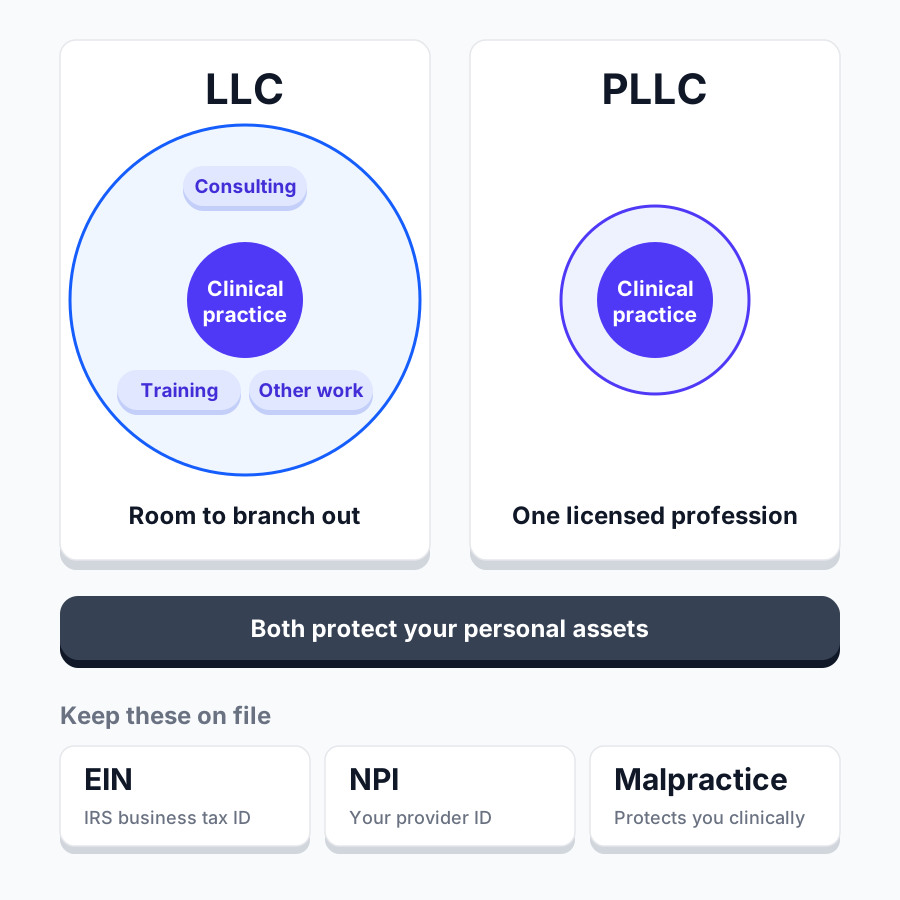
The first decision most people overthink is whether to form an LLC or a PLLC. A PLLC, or Professional Limited Liability Company, is specifically designed for licensed professionals. Therapists, attorneys, physicians. It structures the business around that one profession and that one profession only. An LLC is more general purpose and leaves more room to pivot or add other ventures down the road.
Here’s what I’ll tell you from experience: my first private practice was an LLC and it worked just fine. Both structures give you liability protection. Both are legitimate options. The PLLC is not inherently better, it just draws a tighter circle around what the business is and what it does. If you know you want a pure clinical practice and nothing else, that focus can be a feature. If you think you might branch into consulting, training, or other work down the road, an LLC gives you more flexibility.
Either way, you need liability insurance. That is non-negotiable regardless of which entity you choose. Your malpractice coverage is what protects you clinically. The business structure protects your personal assets. You want both.
Once you file your LLC or PLLC with your state, your next step is applying for your EIN, your Employer Identification Number. This is your business’s national identification number and you can apply for it through the IRS pretty easily after your state filing goes through. You will also want an NPI, a National Provider Identifier, which signals to the system that you are a credentialed provider.
Keep both of these somewhere secure and somewhere you can actually find them. You will need them for taxes, for random administrative paperwork, and especially if you decide to take insurance. Insurance companies want every number you have, every time, without apology. Getting organized with this stuff early saves you a headache later.
Choosing Your Practice Model
Covid did a lot of damage to a lot of industries. For private practice therapists, it was one of the rare silver linings. Telehealth expanded rapidly out of necessity, and what it revealed was a genuine increase in access. Clients and therapists who never would have found each other geographically could now connect. Niche specialties became more viable. Therapists gained location flexibility in a way the field had never really seen before. You can live somewhere else, travel, and still maintain a full caseload as long as you are licensed in the states where your clients are located.
I thought telehealth was going to be my answer when Covid hit and forced the issue. The flexibility seemed perfect. What I realized pretty quickly was that I thrive with some in-person contact. There is something about being in the room with someone that you cannot fully replicate on a screen. The energy, the presence, the thing that made this work meaningful to me in the first place. I needed at least a part time physical space to hold onto that.
In-person or hybrid also gives you a home base and a business address, which people underestimate. It also gives you colleagues in a passing sense, people to exist alongside during the workday. And clinically, seeing someone in person gives you more to work with. Their clothes, their eye contact, their energy walking through the door. That information is telling, especially with higher risk clients.
What you decide here also feeds directly into your pricing. If you are paying rent for office space, that cost has to factor into what you charge, and you really don’t want to skip that math.
Setting Your Fees
Pricing is where a lot of helping professionals genuinely struggle, and usually in the direction of charging too little. So before we talk philosophy, let’s do the math.
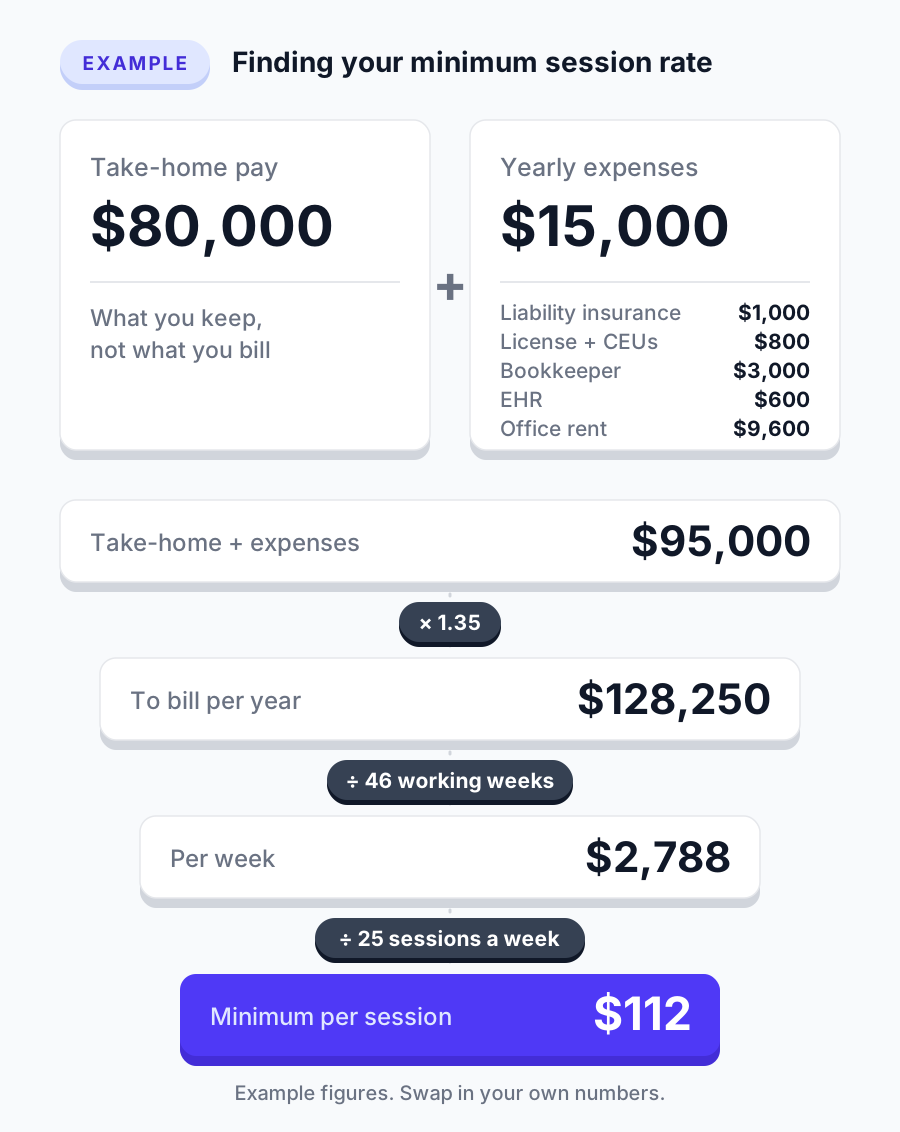
Start with what you want to take home. Not what you bill, what you keep. Now layer in your annual costs: self-employment tax, liability insurance, licensure renewal, CEUs you are required to complete to keep that license, a bookkeeper (worth it, especially early on), your EHR platform, and rent if you have a physical space. The IRS will most likely classify you as a sole proprietor LLC, so you are responsible for both sides of your self-employment tax. Take your desired take-home, add your total annual expenses, and multiply that whole number by 1.35. That is what you need to bill for the year. Divide by how many weeks you plan to work, then divide again by how many sessions per week you want to carry. That final number is your minimum session rate.
If you plan to take insurance, I could write an entire article on that alone and probably will. But the short version is this: factor in not just the rate each insurance panel pays you, but how long it takes to get credentialed with each one. Sometimes you are looking at three weeks. Sometimes it is several months before that approval letter shows up. If you want to move faster, platforms like Headway or Alma can help you get onboarded and have billing infrastructure built in, so factor that into your planning before you count on insurance income to cover your first few months.
One thing worth addressing directly: a 30 session week is not a 30 hour work week. There are notes to write after every session, referrals to coordinate, emails to return, and your own mental recovery time to account for. Build that into how you think about your capacity.
Your hourly rate also represents something almost no other profession asks of a person. Think about the last time someone gave you their full undivided attention for 60 straight minutes. It almost never happens. That is what you are providing every single session. Charge like you’re worth it.
If you plan to offer a sliding scale or take insurance, those decisions affect your take-home further. A sliding scale spot at a reduced rate is not just a discount. It gets absorbed somewhere else in your caseload. Know your numbers before you make those offers.
Building a Caseload That Works for You
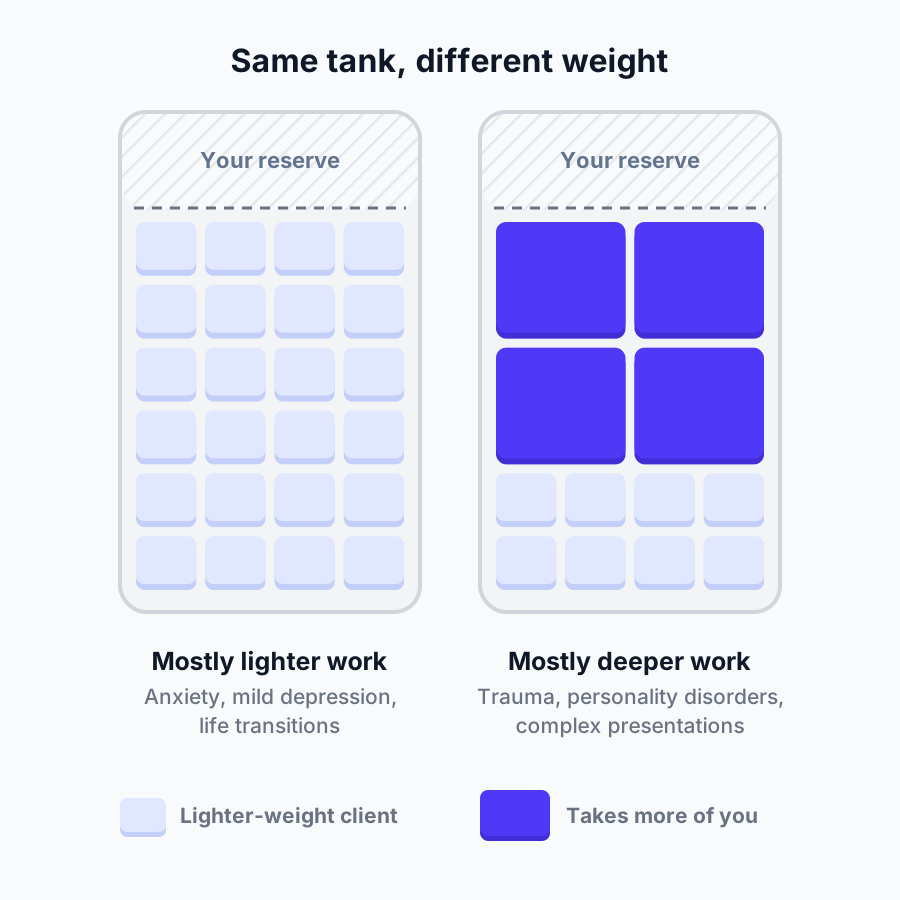
Caseload is not just a number. It is bandwidth and depth.
If the clients you are seeing are taking you into deep water, you need more left in your own tank to get there with them. Twenty to twenty-five clients is a full caseload for most therapists, and even then, not all of them are heavy. Think carefully about who you work best with and what that work costs you. Anxiety, mild depression, life transitions, positive psychology leaning work, those populations tend to allow more flexibility in how many people you can see. Deep trauma, personality disorders, complex presentations - those require complete self command, a level of empathy most people have never had to access professionally, and boundaries so solid your most challenging client cannot move them. Know who you help best and account for what it takes out of you, both in time and in what you carry home.
Also think about what you need to keep in your life outside of sessions. If you are a gym person, protect that morning class like it is a client appointment. If Tuesday and Friday nights are yours, keep them that way. Your recovery time is not a luxury. It is part of how you show up for the people paying you to show up well.
You also do not have to do everything. You are probably not a nurse or a physician, so have referral sources you trust. Know the dietitians, the psychiatrists, the primary care providers in your area who you can send people to when something falls outside your lane. If you work with ED clients and you are trained for that, know who you call for the nutritional piece. A good referral network is not an admission that you cannot handle something. It is good clinical practice.
If you are ramping up and not bringing clients with you from a previous practice, finding your people is its own challenge. Your referral network helps here too, and I would not underestimate the value of introducing yourself to development directors at treatment centers in your area. A warm handoff from someone who already knows and trusts you is worth more than any algorithm. That said, a Psychology Today profile that actually sounds like you, written in your voice, describing the clients you genuinely want to work with, will bring people to your door more than you might expect. It is often the first place someone goes when they are finally ready to ask for help, and you want to be findable when that moment comes.
You cannot burn every end of every candle trying to save people. Pace yourself. The goal is a long career, not a heroic burnout.
Cancellation Policy
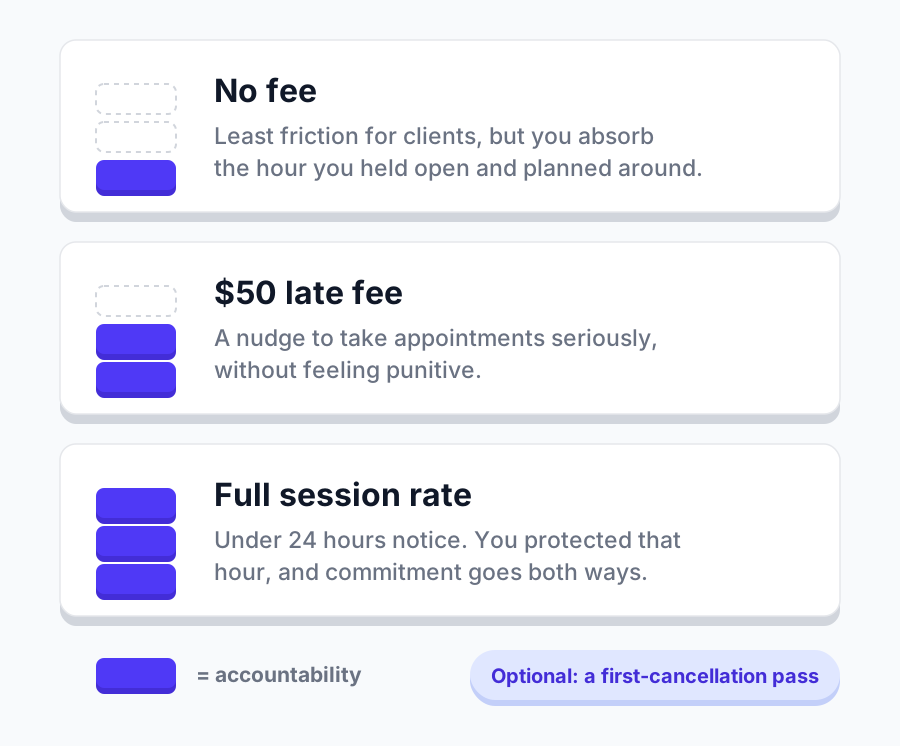
There is no universally wrong cancellation policy. There are just different motivators, and you need to know yours.
If keeping clients happy at all costs is the priority, charge nothing. If there’s no accountability then no friction, and you just absorbed at least $100 for an hour you held open and planned around. If income consistency is important to you, a cancellation fee keeps your schedule from becoming a guessing game. Something like $50 per late cancellation is not unheard of and gives clients enough of a nudge to take their appointments seriously without feeling punitive.
Some providers, and I fall into this category, charge the full session rate for cancellations with less than 24 hours notice. I do this because I protected that hour. I was going to be there. I am not double booking my schedule like an airline to hedge against no-shows and keep my numbers padded. Quality care requires mutual commitment and accountability, and last minute cancellations without consequence are a pattern I do not want to encourage.
You can build in grace. A first cancellation pass is a reasonable human gesture. But whatever you decide, know why you decided it, because that is what lets you enforce it without guilt and sleep at night having done so.
You cannot pour from an empty cup, and a cancelled hour with no fee is a cost to your ability to take care of yourself. You are not being punitive by having a policy. You are running a business that funds your ability to keep helping people.
Choosing an EHR
Your records system is one of those decisions that feels administrative until it becomes urgent, and then it feels very personal very fast.
Paper records are not as antiquated as people assume. There is something to be said for keeping clinicians present and focused in session rather than typing while someone is mid-disclosure. If privacy concerns around AI data scraping keep you up at night, paper removes that variable entirely, and honestly, wanting to keep your session notes off a server somewhere is not a crazy position to take. Pair the paper notes with a tin hat during sessions and you have the full effect. To stay compliant you need two locks between your notes and anyone else, which is achievable. The risks worth planning for are physical ones, fire being the obvious one, and fireproof storage options exist if you want to go that route.
With electronic health records (EHR), the landscape has shifted significantly toward AI driven platforms, and it is worth doing your homework on each one. Search carefully to understand whether a provider uses AI, how they use it, and what that means for your client data.
Before you choose any system, think about what you are tracking and how you work. Do you need robust billing built in? Customizable note templates that match your therapeutic approach? Easy access to treatment plans and progress notes in one place? Your records system should fit how you practice, not the other way around.
I use HIPAAtherapy, and full transparency, they have compensated me for my time and opinion here so I am not a neutral party. That said, I chose them before that relationship existed because they are not AI driven and because of something that is harder to quantify. When I am panicking because I cannot figure out how to charge a client or convinced I have accidentally deleted my entire caseload, the founder Anu emails me back. Sometimes she calls. That kind of personal support is not standard in this industry, and it pays for itself.
Bonus: if you do outgrow your shiny tin hat, HIPAAtherapy also offers a non-AI feature that transcribes your physical handwritten notes into digital records. So you can keep the old school feel without losing the functionality. The cap is optional, the compliance is not.
Whatever system you choose, make sure it includes a Business Associate Agreement. This is not optional, it is what makes you HIPAA compliant from day one. HIPAAtherapy includes this automatically when you sign up, which means your bases are covered before you see your first client.
Final Thoughts
Starting a private practice is one of the most meaningful professional decisions you can make. It also rewards people who go in with their eyes open. Get the structure right, know your numbers, protect your time, and build something you can sustain. The clients who need you are better served by a version of you that is still standing five years from now.